The coronavirus pandemic has caused a historic decline in Germany’s economic output. According to the German Federal Statistical Office, real gross domestic product had dropped by 10.1% quarter-on-quarter on a seasonally adjusted basis in the second quarter.
Commercial activity has dropped in many manufacturing sectors in tandem with the economic contraction. German exports and investments in industrial machinery registered declines. Passenger transport services were affected and the demand for accommodation services decreased due to social distancing requirements.
Landesbank Baden-Württemberg (“LBBW”), however, has remained profitable in spite of the broad macroeconomic concerns. The bank reported a profit before tax of EUR 103m in 1H20 on the back of a strong operating performance in its capital markets and corporate customer businesses.
About LBBW
LBBW is organized under the laws of the Federal Republic of Germany as well as the State of Baden-Württemberg (“BW”), and is registered in the commercial register in Stuttgart, Mannheim, and Mainz. BW, the third most populated state in Germany, is located in Southwest Germany with 11.02m inhabitants in 2018. The community is recognized for its innovation and high productivity. In 2018, BW became the largest exporter state in Germany, recording EUR 203 billion of exports.
As a private commercial entity, LBBW mainly supports customers in Germany and clienteles of affiliated savings banks. These savings banks are a type of bank that help the local state economy and population. Profits are typically used to strengthen the banks’ equity and used for various public welfare community projects. Under the Landesbank Baden-Württemberg Act, LBBW is a public law institution that acts as (i) a universal and commercial bank, (ii) a central bank to the savings banks in the state of BW, Saxony and Rhineland-Palatinate; and (iii) a savings bank in Stuttgart.
Backing from state and member banks
There is good institutional support for the lender. LBBW is owned by the Savings Bank Association of Baden-Württemberg (40.5%), the State of Baden-Württemberg (25.0%), the City of Stuttgart (18.9%), and Landesbeteiligungen Baden-Württemberg GmbH (15.4%). This implies that the BW state owns nearly 41% of the lender, including its interest held through Landesbeteiligungen Baden-Württemberg GmbH.
There is a close relationship between LBBW and the second largest shareholder, the Savings Bank Association of Baden-Württemberg. This association is part of the German Savings Bank Finance Group (Sparkassen-Finanzgruppe; “SBFG”), which is one of the largest banking groups in the world. There are 377 savings bank and six regional state-owned banks, including LBBW, in SBFG. SBFG is presently rated A+ by Fitch Ratings, while LBBW is rated A-.
Member savings banks may contribute directly to the nominee capital of the LBBW, at which point such contributions shall be attributed to the Savings Bank Association of Baden-Württemberg. In accordance with the provisions of the German Banking Act, LBBW may accept capital generated by profit-participation certificates, capital contributions from silent partners, as well as other types of capital from its owners and third parties.
Group segments
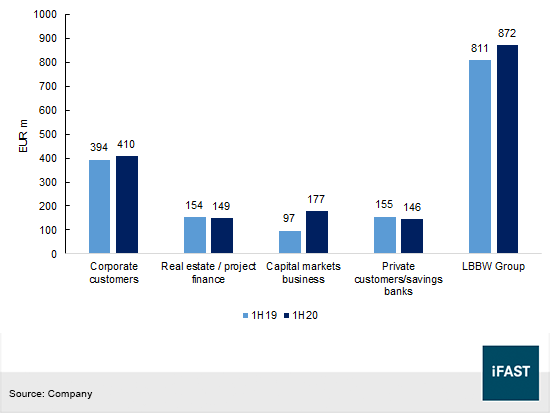
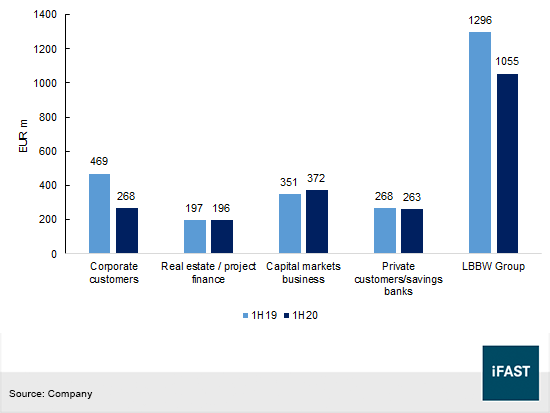
Group results are recognized from four main segments – corporate customers, real estate/project finance, capital markets business and private customers/savings banks. The corporate customers division provides a wide range of products and services to small- and medium-sized companies, including payments, financings, asset management and hedging transactions. As seen in Figure 1, Corporate Customers is the biggest contributor to group’s net interest income, although the division’s net operating income fell behind Capital Markets Business in 1H20 (Figure 3).
Figure 1: Net interest income across segments
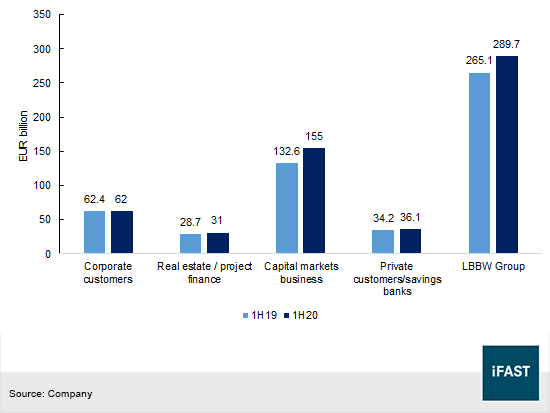
Profit before tax from Corporate Customers turned from positive EUR 159m to a loss of EUR 49m, largely as a result of a meaningful loss allowance on loans and securities. The segment’s assets and cost-to-income ratio in June remained at nearly the same level as a year ago, at EUR 62.0 billion and 62.2% respectively (Table 1).
Table 1: Segment performance ratios
|
Return on equity (%) |
Cost to income ratio (%) |
|||
|
1H19 |
1H20 |
1H19 |
1H20 |
|
|
Corporate customers |
6.7 |
N.M. |
60.9 |
62.2 |
|
Real estate / project finance |
13.6 |
11 |
39.2 |
45.0 |
|
Capital markets business |
8.1 |
10.3 |
71.2 |
66.5 |
|
Private customers/savings banks |
2.1 |
3.5 |
90.6 |
93.3 |
|
LBBW Group |
5.1 |
1.5 |
71.2 |
71.2 |
| Source: Company | ||||
Real estate/project finance
In the real estate/project finance segment, clients gain exposure to commercial real estate. Besides providing refinancing solutions for real estate leases, the segment also structures loans and sets up large-volume transactions. Project Finance, on the other hand, offers financing for infrastructure and energy projects, aircraft and rail vehicles.
With EUR 106m of profit before tax and EUR 31 billion of assets at the end of 1H20 (Figure 5), Real Estate/Project Finance made the highest return on equity across all segments at 11%. Its cost-to-income ratio was notably the lowest at 45%, which is far below the 71.2% ratio at the group level.
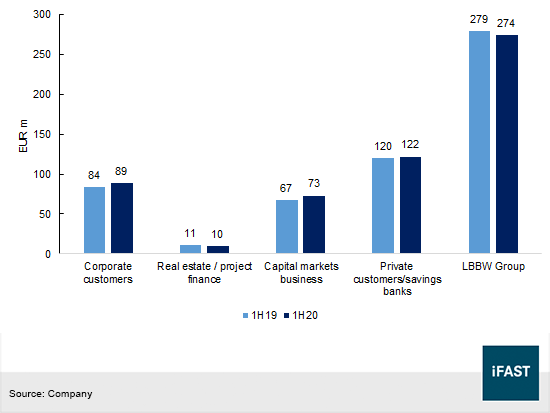
Figure 2: Net fee and commission income across segments
Capital Markets Business
Capital Markets Business caters to savings banks, institutions and other lenders. Customers have access to a variety of services, including securities processing, risk management, custodian bank functions and capital market investments. LBBW’s asset management business is pooled within this segment. At the end of 2019, total mutual fund AUM amounted to EUR 80 billion, up from EUR 72 billion in 2018.
Net interest income from Capital Markets Business increased from EUR 97m in 1H19 to EUR 177m in 1H20 and the segment recorded profit before tax of EUR 372m, highest among LBBW’s divisions (Figure 3). Segment assets climbed to EUR 155 billion and its return on equity rose from 8.1% to 10.3%.
Figure 3: Operating income across segments
Private customers/savings banks
This segment includes income contributions from BW-Bank, the savings bank of Stuttgart, as well as other member lenders. High-net-worth private customers may tap on products and services such as securities management, pension saving solutions and complex asset structures. LBBW shares the credit risk with other savings banks in offering development loans to customers.
Net fee and commission income from Private Customers/Savings Banks was the highest of all segments at EUR 122m in 1H20. As shown in Figure 4, Private Customers/Savings Banks made a small profit of EUR 19m, while its return on equity was among the lowest across the different segments, at 3.5%. This was likely because of elevated operating expenses as the segment’s cost-to-income ratio was 93.3%.
Figure 4: Segmental profit/loss before tax
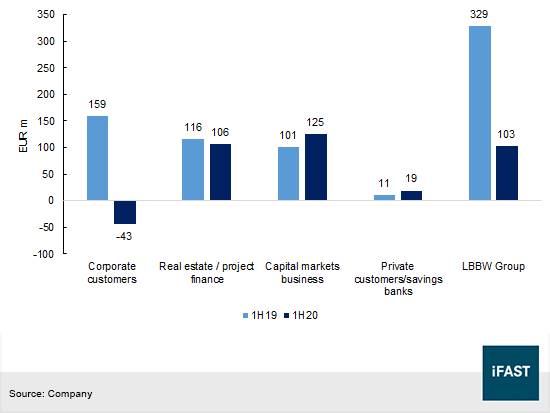
Figure 5: Segment assets
Portfolio quality
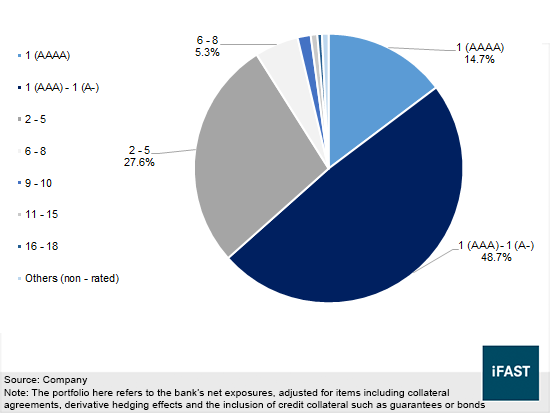
Despite the grim outlook for economic conditions, the group’s asset quality continued to stay at a healthy level at 1H20. The bank’s portfolio did not experience any material deterioration in terms of counterparty default risk. LBBW reported that 91.0% of the portfolio was composed of investment-grade exposures (internal ratings of 1 to 5; see Figure 6), with non-performance exposures accounting for just 0.5% of the entire portfolio.
Figure 6: Portfolio breakdown by internal ratings
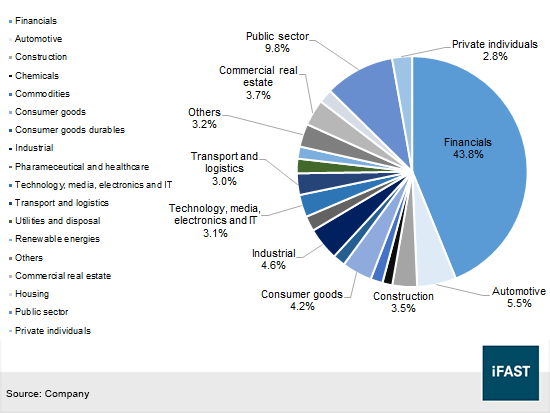
A breakdown of the portfolio by sector reveals that the bank is predominantly exposed to the financial sector, with a net exposure of EUR 96.8 billion or 43.8% of the portfolio (Figure 7). Public sector exposures, which included transactions with German non-central public sector entities, made up 9.8%. Automotive is the most important sector within corporate loans as it accounted for 5.5% of exposures. Management is closely monitoring coronavirus impacts on the portfolio and may reduce exposures to vulnerable corporate sectors.
Figure 7: Portfolio breakdown by corporate sectors
Recent financial performance
Total income, defined as the sum of net operating income, net interest income, net commission income and net gains from re-measurements and disposals, declined from EUR 1,296m in 1H19 to EUR 1,055m in 1H20. Expenses for bank levies and the deposit guarantee system rose to EUR 118m due to a 7.2% rise in covered deposits in the eurozone last year. After taking allowances for losses on loans and securities into account, the group made a net consolidated profit of EUR 52m in 1H20, down from EUR 226m in 1H19.
Referring to Table 2, the bank made an ROE of 1.5% and an ROA of 0.02%. Both ratios were small, but comparably higher than Commerzbank and Deutsche Bank (“DB”).
From a longer term perspective, LBBW’s net revenue and net income remained stable (Figure 8). Using estimates from Bloomberg, LBBW made EUR 2.65 billion of net revenue in the trailing twelve months ended June (“TTM 1H20”), nearly the same level as the past few years. Net income stayed at around EUR 0.44 billion in the three years up to 2019, but dropped recently to EUR 0.28 billion in TTM 1H20.
Figure 8: Net revenue and net income since 2002
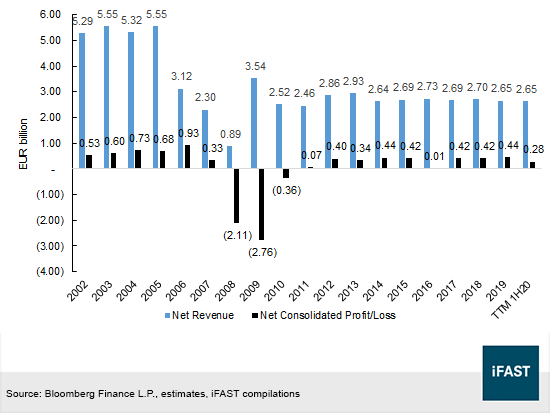
The drop in profitability was partially caused by re-measurement losses on financial assets, including trading instruments and other assets measured at amortized cost. Set against a volatile capital market environment, net results from re-measurement and disposals swung to a net loss of ~EUR 167m in TTM 1H20 from a gain of EUR 169m in 2019. Concurrently, allowances for losses on loans and securities climbed from EUR 151m to ~EUR 369m in TTM 1H20.
On a related matter, we observed that LBBW’s credit provisions were lower than its peers. For instance, the ratio of allowances for losses on loans and securities/loans and advances was 16 basis points (“bps”) during 1H20, moderately lower than Commerzbank (28 bps) and Deutsche Bank (29 bps). If loan allowances of LBBW increased to 28 bps, the bank would have reported a net loss for the six-month period ending 30 Jun 20. Moving forward, we expect credit provisions by LBBW to catch up to its banking peers and this is likely to weigh on future earnings.
Funding discussion
As a state-owned bank, LBBW would not have difficulty accessing financial markets for capital requirements. Deposits from banks increased to EUR 87.0 billion in 1H20 (2019: EUR 66.6 billion), driven by higher amounts of overnight and term money.
Deposits from customers were up by EUR 4.8 billion to EUR 95.1 billion largely due to higher volume of current account liabilities. On this point, Germany’s Bundesbank that overall bank deposits in the country have increased over the second quarter, in line with the decline in economy activity.
Bank customers have reduced their time deposits and this was largely due to a large scale reduction in time deposits from the general government sector. The fall in time deposits related to the financial needs of general governments, at a time of high case counts of Covid-19. Concurrently, there was an upturn in lending to the general government sector that coincided with broad support measures from the government to cope with the economic consequences of the pandemic.
Securitized liabilities expanded by EUR 4.8 billion on the issuance of a GBP 500m green bond, EUR 3.3 billion of securitized money market transactions and EUR 1.0 billion social bond. Subordinated capital, meanwhile, fell to EUR 5.8 billion after the bank repaid part of silent partners’ contributions and subordinated deposits.
Credit factors
Insolvency is clearly not a concern for LBBW right now as liquidity remains at a comfortable level. Cash and cash equivalents added to EUR 33.0 billion, out of which EUR 27.5 billion were held at Deutsche Bundesbank. The bank participated in the ECB’s TLTRO III program that is currently accessible to European institutions on a quarterly basis.
LBBW’s total equity was near the record high of EUR 13.9 billion, mostly unchanged from the end of 2019 (Figure 9). Bloomberg data showed that the bank’s total equity has been on an uptrend since 2002. LBBW’s common equity Tier 1 capital (“CET 1”) – recognized as the highest quality of regulatory capital and a core measure of the bank’s financial strength – rose to EUR 12.03 billion from EUR 11.79 billion over the same period.
Figure 9: Total equity and CET 1 capital
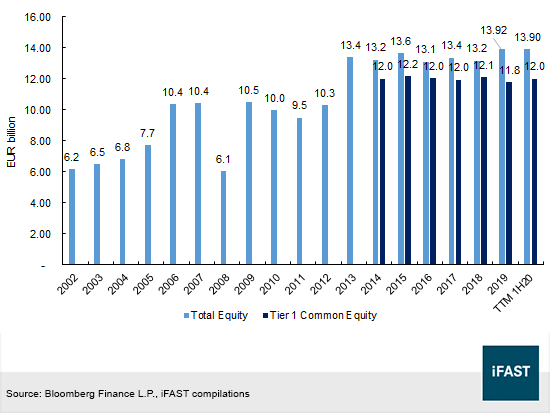
When expressed as a percentage of risk-weighted assets, LBBW’s CET 1 ratio was 14.4% in 1H20 (Table 2), higher than Commerzbank (13.4%) and Deutsche Bank (13.3%). LBBW’s CET 1 ratio comfortably exceeded the 8.98% regulatory minimum requirement.
Table 2: Selected financial ratios during 1H20
|
|
LBBW |
Commerzbank |
Deutsche Bank |
|
Credit provisions as a % of loans |
~16bps |
~28 bps |
~29bps |
|
CET 1 capital ratio |
14.4% |
13.4% |
13.3% |
|
CET 1 capital over total assets |
4.2% |
4.6% |
3.1% |
|
Return on equity |
1.5% |
~-0.24% |
~-4.69% |
|
Return on assets |
~0.02% |
~-0.01% |
~-0.21% |
|
Total capital ratio (fully-loaded) |
22.0% |
17.3% |
17.0% |
|
Tier 1 capital ratio |
15.8% |
14.6% |
15.0% |
|
Leverage ratio |
4.2% |
4.7% |
4.2% |
|
Ratio of bank customer deposits to total deposits |
~47.8% |
~23.0% |
~13.4% |
|
Liquidity coverage ratio |
142.3% |
127.3% |
144.0% |
| Source: Company reports, iFAST estimates | |||
Nonetheless, LBBW’s CET 1 ratio represented a decline from 14.6% in 2019 due to a re-rating of risk-weighted assets tied to coronavirus-related customer developments. LBBW guided that it would manage the CET 1 ratio to stay above its long-term target of ~13%.
On an unweighted basis, the percentage of CET 1 over total assets for LBBW was 4.2%, lower than Commerzbank (4.6%) but more than a percentage point higher than Deutsche Bank (3.1%). All in all, the slightly lower but still solid CET 1 metrics meant that LBBW still had a comfortable measure of core equity capital.
LBBW also has healthy capital adequacy and a stable funding profile within the context of other financial measures. Total capital and Tier 1 capital ratios of 22.0% and 15.8% exceeded peers, while its leverage ratio stayed significantly above the minimum level of 3.0% stipulated by the Basel Committee. LBBW’s liquidity coverage ratio also substantially exceeded the minimum target of 100%, increasing to 142.3% in 1H20 from 123.6% in 2019. On its leverage ratio, the lender guided that higher financial requirements of its customers and stronger business developments will cause the group’s total assets to increase, thereby leading to a decline in the leverage ratio from its present level of 4.2%.
As a central bank to other savings banks, LBBW acts as a partner to bank customers through the course of Covid-19. The bank’s credit profile is intricately linked to its banking customers as it provides credit and ensures sufficient liquidity for other banking institutions. This is seen from the high deposit ratio of banking customers at LBBW, which stands above the ratios of Commerzbank and Deutsche Bank.
Subordinated bond discussion and recommendation
Capital instruments issued by LBBW are extensively covered by the credit rating agencies. Based on the rating agencies’ assessment, LBBW’s long-term issuer and unsecured debt credit ratings suggest that the lender has the strongest credit profile among the three aforementioned German banks (Table 3).
Table 3: Credit ratings
|
|
S&P Global Ratings |
Moody’s Investors Service |
Fitch Ratings |
|
Long-term issuer rating (Commerzbank) |
BBB+, negative |
A1, stable |
BBB, negative |
|
Long-term issuer rating (DB) |
BBB+, negative |
A3, negative |
BBB, negative |
|
Long-term issuer rating (LBBW) |
NR |
Aa3, stable |
A-, negative |
|
Preferred senior debt (Commerzbank) |
BBB+ |
A1 |
BBB+ |
|
Preferred senior debt (DB) |
BBB+ |
A3 |
BBB+ |
|
Preferred senior debt (LBBW) |
NR |
Aa3 |
A |
|
Non-preferred senior debt (Commerzbank) |
BBB- |
Baa2 |
BBB |
|
Non-preferred senior debt (DB) |
BBB- |
Baa3 |
BBB |
|
Non-preferred senior debt (LBBW) |
NR |
A2 |
A- |
|
Subordinated debt (Commerzbank) |
BB+ |
Baa3 |
BB+ |
|
Subordinated debt (DB) |
BB+ |
Ba2 |
BB+ |
|
Subordinated debt (LBBW) |
NR |
Baa2 |
BB+ |
|
Additional Tier 1 securities (Commerzbank) |
BB- |
Ba2 |
NR |
|
Additional Tier 1 securities (DB) |
B+ |
B1 |
B+ |
|
Additional Tier 1 securities (LBBW) |
N.A |
N.A |
N.A |
| Source: Company websites, information retrieved on 23 Sep 20. | |||
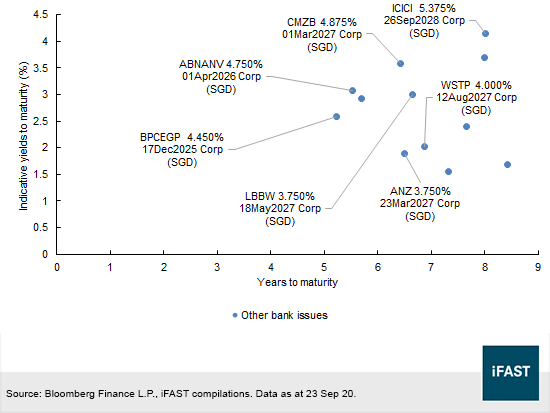
We compared the indicative yields to maturity (“YTM”) of subordinated SGD issues among the three issuers (Figure 10). With a YTM of 3.01%, we think the LBBW 3.750% 18May2027 Corp (SGD) is comparatively less attractively priced relative to the other notes.
In our view, there is more value in the CMZB 4.875% 01Mar2027 Corp (SGD) given the CMZB 4.875% 27s’ higher YTM of 3.59%. However, the LBBW 2.75% ‘27s seem better priced compared to the WSTP 4.000% 12Aug2027 Corp (SGD) and ANZ 3.750% 23Mar2027 Corp (SGD) considering their higher yield. Westpac Banking Corporation has issuer ratings of A+/Aa3/AA- by Fitch/Moody’s/S&P, while senior credit ratings of Australia and New Zealand Banking Group Limited were A+/Aa3/AA- correspondingly.
The LBBW 3.75% ‘27s are callable on 18 May 22 at par. If the bank does not redeem the bond on the first call date, the coupon rate would reset to the sum of the prevailing five-year SGD swap offer rate and the initial spread of 178 bps. Investors should also be mindful that as a Tier 2 capital instrument, the LBBW 3.75% ‘27s are subject to a write-down or conversion (to CET 1 instruments) in an insolvency or liquidation scenario of the bank.
Figure 10: Relative value among SGD-denominated subordinated bank notes
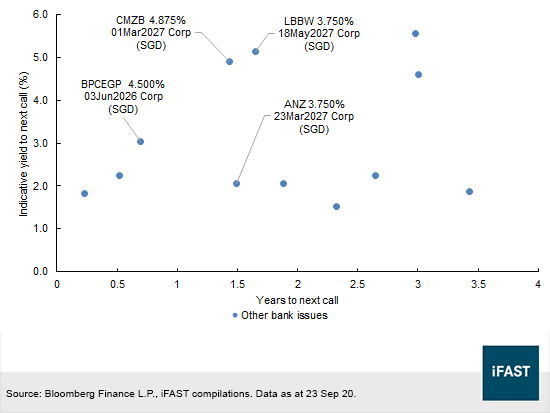
From the perspective of another valuation measure, the LBBW 3.75% ‘27s are priced at an indicative yield to next call (“YTC”) of 5.13%, representing one of the highest yields within the sector (Figure 11). Other bonds such as the CMZB 4.875% ‘27s and ANZ 3.75% ‘27s had lower YTCs of 4.91% and 2.05% respectively.
At this point, it is difficult to predict if LBBW will call the notes in two years given the high uncertainty in Germany’s economy, hence we think it is prudent to put more weight in the yield to maturity/worst measure. Our preference thus leans towards the CMZB 4.875% ‘27s due to their higher YTM. Furthermore, a 22 bps YTC difference makes little distinction between the two issues in our view.
Figure 11: Relative value using indicative yields to next call
Deutsche Bank AG and BPCE SA opted not to redeem their dim sum Tier 2 bonds on their call dates in April (DB 3.6705% notes due in April 2025) and March (BPCEGP 3.9866% notes due in March 2025) respectively. The call dates coincided with the peak of market volatility and the issuers may have decided to conserve capital in view of the weak funding conditions back then. These events suggest that investors should adopt the YTM/YTW valuation as a conservative measure of yield among the bank capital instruments.
Ending note
Falling profitability and a low interest rate environment are challenging non-savings banks in Germany. The number of banks has declined from 1,864 in 2008 to 1,530 in June 2020. This translates to an average closing rate of approximately 29 banks every year. The number of state-owned banks has also dropped from 10 in 2008 to 6 in June 2020.
After identifying potential vulnerabilities in the eurozone banking sector earlier this year, the ECB had imposed a ban to stop banks from paying dividends to shareholders. A short-term dividend ban is understandable given the uncertainties around the impact from loan loss provisions, but an extended long-term ban could dampen the investment appeal of European banks and lead to an increase in their cost of capital.
However, stronger banks like LBBW will survive the potential transitory headwinds and emerge stronger in the longer term. The bank has the support of the state and adequate capitalization.
With an indicative yield to maturity of 3.01% and yield to next call of 5.13%, investors may consider investing in the LBBW 3.750% 18May2027 Corp (SGD) in light of the bank’s healthy funding profile. LBBW’s customer and bank deposit base has been resilient in 1H20. Not to mention, the group’s regulatory liquidity coverage ratio and capital adequacy metrics were easily above requirements.
Declaration:
For specific disclosure, at the time of publication of this report, IFPL (via its connected and associated entities) and the analyst who produced this report hold a NIL position in the abovementioned securities.
Our podcast series, Yield Hunters, is available on Spotify and iTunes Podcasts and Google Podcasts. We share our thoughts on new bond issues and hold discussions on the fixed income space. Listen to our latest episode below and follow us!